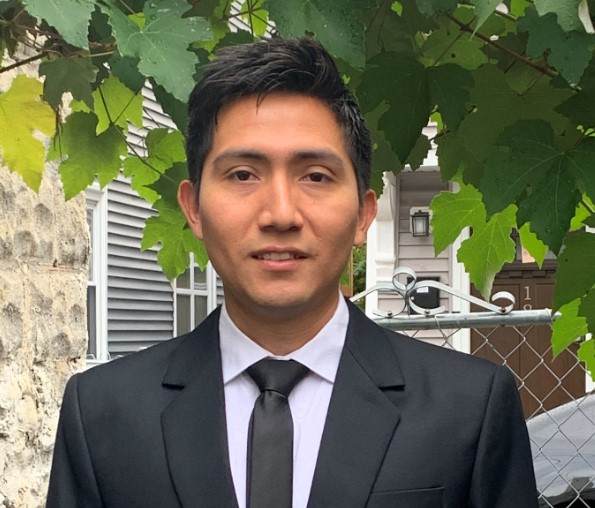
Hi! I'm a Ph.D. student in Computing and Mathematical Sciences at Caltech. Before that, I did an M.S. in Computer Science at Cornell and was a researcher at the World Bank Data Lab. Here is my CV.
I work on the economics of AI, especially how AI coding agents change what software developers build.
Working Papers
-
Agentic Delegation and the Language Frontier of Software Developers: A Model and Evidence from Claude Code on GitHub
When developers adopt Claude Code, the set of programming languages they work in roughly triples, and first uses of unfamiliar languages concentrate among narrow specialists.
-
Agentic AI and the Industry Composition of Developer Work
Around first Claude Code use, developers' public work spreads into new industries: monthly distinct sectors nearly triple, and the cumulative sectoral footprint stays about 50% higher.
-
Renting Intelligence: Student Responses to an Exogenous Downgrade in AI Model Quality
When GitHub moved students from Copilot Pro to a plan without premium models, their AI-assisted commits fell by roughly 83% of the pre-period mean relative to matched controls.
-
A Unified Economic Model of Agentic Coding Automation
How many coding agents can an organization run? The tightest of verification, isolation, and demand constraints sets the scale, and the practitioners' five maturity stages correspond to which one binds.
-
Impact of the Availability of ChatGPT on Software Development: A Synthetic Difference in Differences Estimation using GitHub Data
Using government bans of ChatGPT as natural experiments, we find that access raised git pushes, repositories, and developers per capita on GitHub.
Earlier Work
- Can Market Competition Reduce Public Sector Corruption?
- High Dimensional Metrics in Julia
- Fertility and Education Patterns Across Different Phases of Development
Software
Causal ML packages
- csdid: average treatment effect parameters in Difference-in-Differences, including doubly robust estimation.
- DRDIDpy: estimators for the ATT in DiD when parallel trends hold after conditioning on pre-treatment covariates.
- TreatmentEffectRisk: bounds and inference for treatment effect risk.
- synthdid.py, synthdid.jl: Python and Julia implementations of Synthetic Difference-in-Differences (Arkhangelsky et al., 2021).
- HDMjl: estimation methods for high-dimensional models in Julia (Chernozhukov et al., 2016).
- Sensemakr.jl: sensitivity analysis tools in Julia (Cinelli et al., 2020).
Books and teaching resources
- Inference on Causal and Structural Parameters using ML and AI, used in course 14.388 at MIT [R][Python][Julia]
- Machine Learning and Causal Inference, used in course MGTECON 634 at Stanford [R][Python]
AI projects
- ILLA: an AI assistant that helps identify potential obstetric and gynecological violence [media]
- DigitalPillarAI: a GPT-4 tool that classifies World Bank Project Appraisal Documents into six pillars.
- llm4tesis: a GPT-4 tool that generates research questions from the PUCP Economics thesis repository.
News
- Oct 2026 Presented a poster on Agentic Delegation and the Language Frontier at Empirical Methods in the Age of AI, Stanford.
- Jul 2026 Presented Agentic Delegation and the Language Frontier at the Open and User Innovation Conference 2026, Harvard Business School.
- Jul 2026 Selected for Anthropic's Claude for Open Source Program.
- Jul 2026 Three new drafts on agentic AI and software work: Renting Intelligence, Industry Composition, and A Unified Model of Agentic Coding Automation.
- May 2026 Agentic Delegation and the Language Frontier of Software Developers is on arXiv.
- Sep 2025 Started my Ph.D. in Computing and Mathematical Sciences at Caltech.
Teaching
-
Causal Inference and Machine Learning
Graduate course, Universidad del Pacífico, 2024 [GitHub][students]
Graduate course, Department of Economics, PUCP, 2021 [GitHub][students] -
Python Intensive Course
Graduate course, Laboratory of Artificial Intelligence and Computational Methods in Social Sciences, PUCP, 2021 [GitHub][students] -
Python Bootcamp
The Code Blinders, 2021 [GitHub]
Research Team
Alumni: Karl Janampa (SGS Peru), Rodrigo Grijalba (Predoc, Princeton), Jhon Flores (LSE), Valeria Albarracin (Diplomatic Academy of Peru), Franco Cáceres, Sandra Martinez (Columbia), Roberto Mendoza (Predoc, Princeton), Anzoni Quispe (Predoc, Princeton), Yoseph Ayala (RA, Columbia), Elibeth Cirilo (University of Warwick), Jesus Soto (Data Scientist, Interbank)